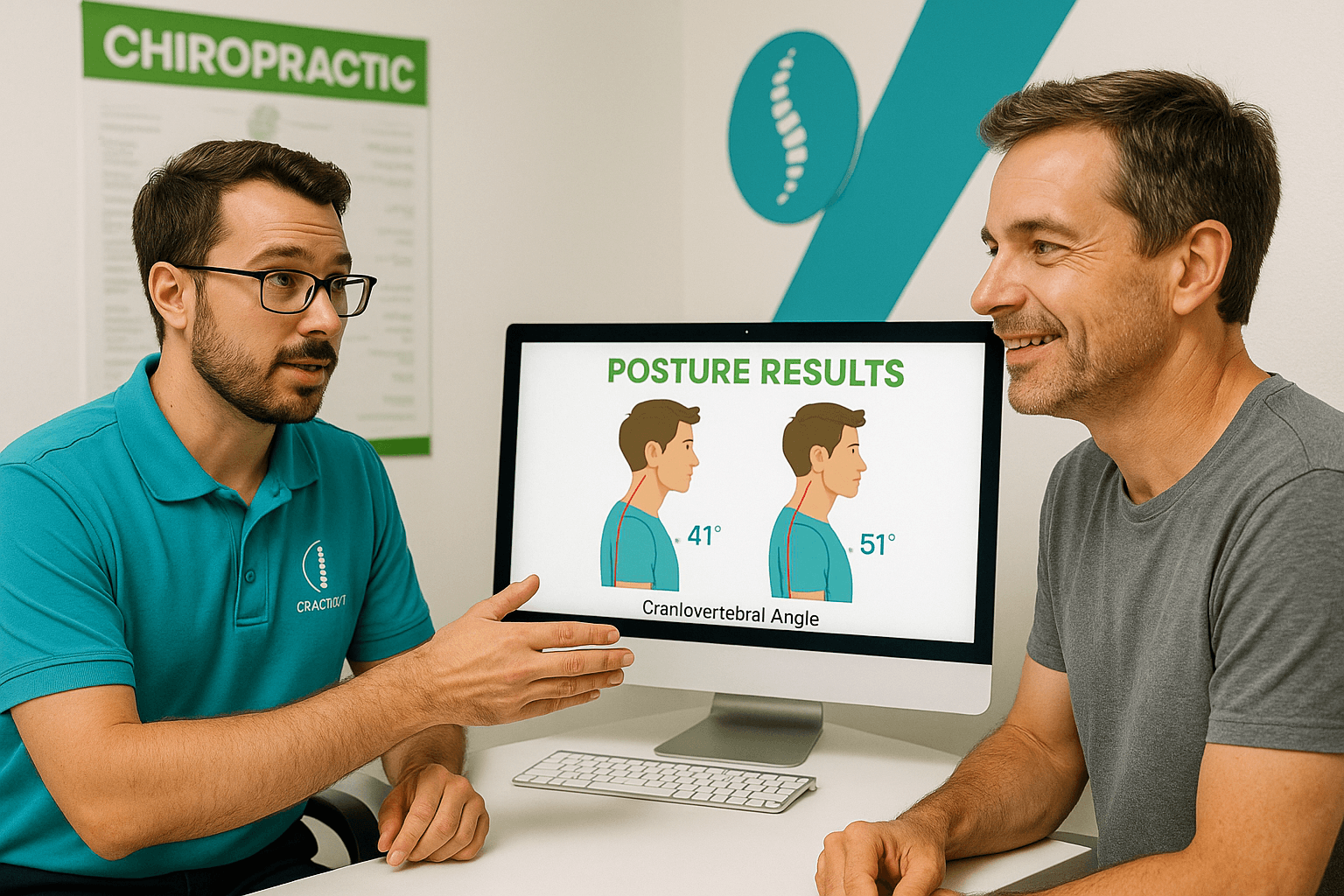
Structural Change May Not Feel the Same From Week to Week
The human body continuously adapts to the positions and movements used during everyday life. When someone has spent years sitting, standing, walking, working, exercising, or sleeping in familiar ways, those patterns can begin to feel normal even when certain areas are consistently working harder than others.
Structural correction introduces a different objective.
Rather than asking someone to consciously “sit up straight” for a few minutes, Upright Posture uses Advanced BioStructural Correction™ as its primary structural approach. Within the ABC framework, treatment is intended to address structural misalignments that the method proposes the body cannot self-correct, while allowing existing compensation patterns to change over time.
As those patterns change, the way a person experiences muscular tension, stiffness, movement, and body awareness may also change. Understanding that possibility can make the process less confusing while still leaving room to investigate symptoms that do not fit the expected pattern.
Jump To:
- TLDR Quick Guide
- What Does Tension During Structural Correction Mean?
- What Are Compensation Patterns?
- What Is the ABC Unwinding Process?
- Why Might an Old Ache Become Less Noticeable?
- Why Can Tension Appear Somewhere New?
- Can Muscles Feel Different When Posture Changes?
- Why Can Increased Body Awareness Affect What You Notice?
- Why Symptoms May Not Improve in a Straight Line
- How Daily Habits Can Influence Changing Tension
- Can Desk Work Affect the Way Structural Changes Feel?
- Can Exercise Change Aches During Structural Correction?
- What Role Does Previous Injury Play?
- Is More Soreness a Sign That Structural Correction Is Working?
- Should You Try to Force Your New Posture?
- How Should You Track Changing Symptoms?
- When Should You Tell Your Practitioner About New Tension?
- When Should Changing Pain Receive Medical Attention?
- How Long Can Changing Tension Last?
- How Is Progress Better Measured?
- Why Structural Correction Requires Individual Assessment
- How Upright Posture Approaches Changing Symptoms
- What Can You Do Between Structural Correction Sessions?
- Setting Realistic Expectations for Structural Correction
- Key Takeaways
- FAQs
TLDR Quick Guide
Understanding Changing Aches and Tension
- Structural correction does not necessarily produce a perfectly linear change in symptoms.
- Familiar aches may decrease while other areas temporarily become more noticeable.
- Long-standing posture and movement habits can involve multiple areas of the body.
- Within the ABC framework, the body may develop compensations around structural problems.
- ABC practitioners use the term “unwinding” to describe changes in those compensation patterns during care.
- Unwinding is terminology specific to the ABC approach and should not be treated as a universally established medical mechanism.
- A change in where you feel tension does not automatically mean your condition is worsening.
- It also does not automatically prove that structural correction is causing the symptom.
- Muscles may feel different as movement and loading patterns change.
- Increased body awareness can make previously overlooked sensations more noticeable.
- Work, exercise, sleep, stress, footwear, and daily activity can also influence aches and tension.
- Avoid judging progress solely by how you feel on one particular day.
- Discuss changing symptoms with your practitioner so they can be considered alongside posture and movement findings.
- Severe, rapidly worsening, persistent, or otherwise concerning symptoms require appropriate evaluation.
- New neurological symptoms should not simply be assumed to be part of structural correction.
- The objective should be meaningful improvement in function and comfort over time, not simply tolerating unexplained pain.
What Does Tension During Structural Correction Mean?
The Experience Can Differ Between Individuals
“Tension” is a broad word.
One person might use it to describe tight shoulders. Another may mean stiffness through the lower back, muscular fatigue around the hips, pressure through the neck, or a sensation that one side is working harder than the other.
That distinction matters because there is no single explanation for every ache or feeling of tightness.
When structural correction changes how someone stands or moves, the mechanical demands placed on different areas may also feel different. At the same time, everyday factors unrelated to treatment can influence what a person feels.
The useful question is therefore not simply, “Is tension normal?”
It is, “What has changed, where is it happening, how severe is it, what makes it better or worse, and does it need further assessment?”
What Are Compensation Patterns?
The Body Can Adapt Around Familiar Movement Strategies
Compensation is a useful concept for understanding why posture can become complicated.
Imagine someone who consistently shifts weight toward one side. Other parts of the body may adopt positions or movement strategies that allow that person to continue walking, standing, working, and exercising.
Over time, those strategies can become familiar.
The person may stop noticing the original pattern because it has become their everyday baseline.
Upright Posture’s ABC approach places considerable emphasis on these structural compensation patterns. Within that framework, some postural changes are viewed as adaptations the body has developed around underlying structural issues.
That is the clinic’s treatment model rather than a universal explanation for all musculoskeletal pain. Pain and tension can have many causes, which is why assessment remains important.
What Is the ABC Unwinding Process?
Upright Posture Uses “Unwinding” to Describe Progressive Change
One of the more distinctive concepts within ABC is “unwinding.”
Upright Posture describes the unwinding process as the gradual change of compensatory patterns as structural corrections are made. In the ABC framework, posture may therefore change in stages rather than moving directly from an initial presentation to a final result.
This concept can help explain why someone undergoing ABC care might not experience the same sensations at every stage.
However, terminology matters.
“Unwinding” is part of the ABC framework and should not be interpreted as proof that every new sensation is evidence that a correction is working. Changing symptoms still need to be discussed and assessed on their own merits.
Why Might an Old Ache Become Less Noticeable?
Changes in Movement Can Change What You Feel
If posture or movement changes, an area that previously felt overloaded may begin to feel different.
For example, a person who habitually holds their shoulders in a particular position may experience muscular effort differently if that posture changes.
The same principle can apply elsewhere in the body.
That does not establish a simple one-to-one relationship between a structural correction and pain relief. Musculoskeletal symptoms can fluctuate for numerous reasons, including activity, recovery, sleep, stress, exercise, workload, previous injury, and health conditions.
This is why longer-term patterns are generally more informative than one particularly good day.
Why Can Tension Appear Somewhere New?
A New Sensation Does Not Automatically Mean a New Injury
This can be one of the more confusing experiences during any process involving changes in movement or posture.
Perhaps the lower back was originally the main concern, but now the person notices muscular tension higher in the back. Or an area that previously received little attention suddenly feels more noticeable.
Several possibilities need to be considered.
Changing movement may alter muscular demand. Increased attention to posture may make the person more aware of sensations that previously went unnoticed. Exercise, work, sleep, or another unrelated factor may also be contributing.
Within ABC, changing sensations may additionally be discussed in the context of changing compensation patterns.
The important point is not to automatically label the new sensation as either “good” or “bad.”
It should be evaluated in context.
Can Muscles Feel Different When Posture Changes?
Muscles Respond to How You Move and Load Your Body
Muscles do not operate independently from posture and movement.
They produce force, control movement, stabilize joints, and respond to the demands placed on the body.
If those demands change, muscular effort can change as well.
A position that feels effortless because it has been used for years may feel different when someone begins moving in another way. Likewise, muscles that have been working in a particular pattern may respond differently when the pattern changes.
That does not mean soreness is required for structural improvement.
More pain is not inherently evidence of more progress.
Any significant or persistent change should be communicated to the practitioner rather than deliberately pushed through.
Why Can Increased Body Awareness Affect What You Notice?
Paying Attention Can Make Subtle Sensations Easier to Recognise
Beginning posture-focused care often causes people to pay more attention to their bodies.
They notice how they stand while waiting in a queue.
They become aware of which shoulder carries a bag.
They recognise that they always cross the same leg.
They notice how they sit at a desk or which side they sleep on.
That increased awareness can also apply to physical sensations.
A mild area of tension that previously blended into the background may suddenly become noticeable because the person is actively monitoring posture and movement.
This does not mean the sensation is imaginary.
It means perception and attention are part of how people experience their bodies, so a newly noticed sensation does not necessarily represent a newly developed structural problem.
Why Symptoms May Not Improve in a Straight Line
Day-to-Day Fluctuation Is Common With Musculoskeletal Complaints
Many people evaluate progress by comparing today with yesterday.
That can create frustration.
Musculoskeletal symptoms often fluctuate. Someone can have a comfortable day followed by a stiffer morning without necessarily having lost all previous progress.
Daily life keeps happening during treatment.
You may spend eight hours at a desk one day and remain active the next. You may sleep poorly, complete a difficult workout, take a long drive, change shoes, lift something heavy, or experience an unusually stressful week.
All of those factors can influence how the body feels.
For that reason, meaningful progress is usually better considered across a longer period rather than judged by one isolated increase or decrease in discomfort.
How Daily Habits Can Influence Changing Tension
Structural Care Does Not Happen in Isolation
What happens outside the clinic can matter just as much to how someone feels on a particular day.
Consider a typical week.
Monday involves prolonged desk work.
Tuesday includes a gym session.
Wednesday requires several hours of driving.
Thursday brings poor sleep.
Friday involves carrying bags or equipment.
A change in tension during that week cannot automatically be attributed to one treatment session.
When discussing symptoms with a practitioner, provide context about changes in exercise, workload, sleep, travel, footwear, injuries, medication, illness, or other relevant factors.
That information can make the symptom pattern much easier to interpret.
Can Desk Work Affect the Way Structural Changes Feel?
Repeated Positions Can Continue to Influence the Body
Receiving structural care does not remove the physical demands of everyday life.
Someone may leave a session and return directly to several hours at a laptop.
Another person may spend the afternoon driving.
Another may work in a physically demanding occupation.
These activities create their own movement and loading patterns.
Changing position regularly, setting up workspaces appropriately, and following individual advice from relevant professionals may help manage these demands.
Structural correction should not be viewed as permission to ignore ergonomics, movement habits, or recovery.
Can Exercise Change Aches During Structural Correction?
Training Adds Another Physical Demand
Exercise can make symptom interpretation more complicated.
Strength training, running, cycling, golf, team sports, yoga, or a new fitness programme can all create muscular sensations independently of structural care.
If you suddenly increase training volume while undergoing posture correction, a new ache may have several possible explanations.
That does not mean exercise needs to stop automatically.
Instead, communicate meaningful training changes to your practitioner and adjust activity when appropriate.
If exercise produces sharp pain, significant weakness, neurological symptoms, or another concerning response, seek appropriate assessment rather than assuming it is simply part of adaptation.
What Role Does Previous Injury Play?
Old Injuries Can Influence How People Move
A previous ankle injury may change how someone loads a leg.
A shoulder injury can alter arm movement.
A history of back pain may lead someone to avoid particular movements long after the original episode.
These adaptations can become habitual.
When movement changes during structural care, previous injury history may therefore be relevant to understanding what someone experiences.
That does not mean structural correction literally “releases” every old injury.
A detailed history helps the practitioner distinguish established patterns from new problems and decide when another type of clinical evaluation may be appropriate.
Is More Soreness a Sign That Structural Correction Is Working?
Pain Should Not Be Used as a Measure of Success
No.
It is important not to develop the belief that increasing pain proves treatment is working.
Some people may experience changing muscular sensations during care, while others may not. Neither experience by itself demonstrates whether structural correction is successful.
Progress should be considered more broadly.
Depending on the person’s goals, useful changes might involve comfort, movement, posture, tolerance of everyday activities, or other agreed measures.
Pain that is severe, worsening, persistent, or otherwise concerning deserves assessment rather than celebration.
Should You Try to Force Your New Posture?
Constantly Holding Yourself Rigidly Can Create More Tension
People interested in posture often start consciously correcting themselves throughout the day.
Shoulders back.
Chest up.
Chin tucked.
Back straight.
Hold everything.
That can become exhausting.
A rigidly held position is not necessarily the same thing as comfortable, sustainable posture, and excessive muscular bracing can itself create fatigue or tension.
Upright Posture’s posture correction approach focuses on structural care rather than asking people to consciously force themselves into an idealised position all day.
The practical lesson is that posture should not become a continuous strength test.
How Should You Track Changing Symptoms?
Look for Patterns Rather Than Isolated Moments
A simple record can help if symptoms are changing frequently.
You do not need an elaborate spreadsheet.
Note:
- Where you feel the sensation
- When it started
- Whether it is improving or worsening
- What activities affect it
- Whether it is present at rest
- Whether movement changes it
- Whether sleep affects it
- Whether exercise affects it
- Whether there are additional symptoms
- How it compares with your original complaint
Patterns often become easier to recognise when they are written down.
This information can also make conversations with your practitioner or another healthcare professional more specific.
When Should You Tell Your Practitioner About New Tension?
Communication Should Be Part of the Process
Do not assume your practitioner already knows what has changed.
Explain new symptoms clearly.
Describe the location, quality, intensity, timing, and activities associated with them.
Mention whether the symptom began suddenly or gradually.
Also explain whether it is fundamentally different from the sensations you have previously experienced.
Good communication allows the practitioner to consider the change alongside treatment history, posture, movement, and other relevant factors.
If the symptom falls outside what they consider appropriate for their scope of care, referral or medical assessment may be warranted.
When Should Changing Pain Receive Medical Attention?
Not Every Symptom Should Be Explained Through Posture
This is particularly important.
New symptoms should not automatically be interpreted as “unwinding,” compensation, or evidence that structural correction is progressing.
Seek appropriate medical advice when symptoms are severe, rapidly worsening, unexplained, or accompanied by concerning features.
Examples that can warrant prompt or urgent assessment include significant weakness, new numbness, loss of coordination, major trauma, chest pain, difficulty breathing, loss of bladder or bowel control, numbness around the saddle area, fever with significant unexplained pain, or other sudden neurological changes.
The appropriate response depends on the symptom and its severity.
When there is uncertainty about a potentially serious symptom, obtaining medical advice is safer than assuming it is posture-related.
How Long Can Changing Tension Last?
There Is No Universal Timeline
People naturally want a timetable.
Unfortunately, there is no responsible way to say that every change in muscular tension should disappear within a particular number of hours, days, or sessions.
Individuals differ in their starting condition, activity levels, health, injury history, work demands, treatment response, and many other factors.
The nature of the symptom matters as well.
Mild temporary muscular awareness is very different from severe or progressively worsening pain.
Instead of using a universal timeline, monitor the direction of change and communicate persistent concerns.
How Is Progress Better Measured?
Look Beyond a Single Pain Score
Pain matters, but it is not the only possible measure of progress.
Someone might also consider:
- Ease of standing
- Comfortable walking
- Movement confidence
- Tolerance for work
- Ability to exercise
- Postural changes
- Frequency of symptoms
- Duration of symptoms
- Recovery after activity
- Ability to perform everyday tasks
The most useful measures depend on why the person sought care in the first place.
Establishing those goals early can make it easier to determine whether care is producing meaningful changes over time.
Why Structural Correction Requires Individual Assessment
Two People With Similar Posture May Have Different Needs
Photographs can make posture look simple.
One shoulder appears higher.
The head appears forward.
The pelvis looks uneven.
But similar appearances do not necessarily have the same cause or require the same approach.
Health history, previous injuries, work, exercise, symptoms, movement, and individual structure all provide additional context.
That is why general online information cannot determine whether a particular ache is caused by compensation, structural change, exercise, injury, or something else.
Assessment matters more than assigning a label from a symptom list.
How Upright Posture Approaches Changing Symptoms
ABC Care Considers Structure and Compensation Over Time
Upright Posture uses Advanced BioStructural Correction™ as its primary framework for structural care.
Within ABC, practitioners consider structural patterns and the compensations the method proposes develop around them. As corrections are made, changes may be interpreted within what ABC calls the unwinding process.
That framework can provide a way of discussing changing posture and sensations, but it should not become an explanation for every symptom.
The clinically responsible approach is to monitor changes, assess them in context, and recognise when something requires investigation outside structural care.
That distinction is especially important when symptoms are new, severe, unusual, or progressively worsening.
What Can You Do Between Structural Correction Sessions?
Support the Process Without Obsessing Over Every Sensation
People can become so focused on posture that they monitor themselves constantly.
That can make every minor sensation feel significant.
A more practical approach is to continue normal activities as advised, follow any individual recommendations from your practitioner, maintain sensible movement habits, and report meaningful changes.
Avoid forcing yourself into rigid positions all day unless specifically instructed for a clinical reason.
Also resist the temptation to repeatedly test painful movements simply to see whether the sensation is still present.
Give your practitioner useful information, but allow everyday movement to remain everyday movement.
Setting Realistic Expectations for Structural Correction
Progress Is Better Viewed as a Pattern
Structural correction should not be judged by the expectation that every session immediately eliminates another symptom.
The ABC model itself describes structural change as a process rather than a single correction.
For patients, the practical takeaway is to look at the overall direction.
Are everyday activities becoming easier?
Are recurring symptoms less frequent?
Are you more comfortable for longer periods?
Has your posture or movement changed in ways relevant to your goals?
Those questions provide a more useful perspective than expecting every day to feel better than the previous one.
At the same time, ongoing treatment should not be used to dismiss unexplained deterioration. If the overall direction is concerning, discuss it and seek additional assessment where appropriate.
Key Takeaways
Changing Sensations Need Context, Not Assumptions
- Tension during structural correction may change as posture, movement, activity, and body awareness change.
- Symptoms do not necessarily improve in a perfectly straight line.
- Upright Posture uses Advanced BioStructural Correction™ as its primary structural-care framework.
- ABC describes compensation patterns as adaptations around structural issues that the method seeks to address.
- “Unwinding” is ABC terminology for progressive changes in those compensation patterns.
- The unwinding concept should not be treated as proof that every new symptom is caused by treatment.
- A familiar ache becoming quieter may change which other sensations you notice.
- New tension does not automatically indicate a new injury.
- It also does not automatically mean treatment is working.
- Muscular demand can feel different when movement patterns change.
- Increased body awareness may make previously overlooked sensations easier to notice.
- Work, exercise, sleep, stress, driving, and daily activity can influence symptoms.
- Previous injuries may influence long-standing movement strategies.
- More soreness should never be used as a measure of treatment success.
- Constantly forcing an upright position may create unnecessary muscular tension.
- Tracking symptoms can help identify meaningful patterns.
- Communicate new or changing symptoms clearly to your practitioner.
- Progress can be considered through function, movement, symptom frequency, activity tolerance, and other individual goals.
- There is no universal timetable for changing tension.
- Severe or rapidly worsening symptoms require appropriate assessment.
- New neurological symptoms should not simply be labelled as structural unwinding.
- Structural care should recognise when medical evaluation or another healthcare approach is appropriate.
- Individual assessment is more useful than trying to diagnose changing symptoms from posture alone.
- Long-term trends generally provide more information than one unusually good or bad day.
- The objective is meaningful, sustainable improvement rather than learning to tolerate unexplained pain.
FAQs
Is tension during structural correction normal?
Some people may notice changes in muscular tension or body awareness while their posture, movement, and everyday activity patterns are changing. Within the ABC framework, practitioners may discuss some of these changes in relation to compensation and the unwinding process, although that does not explain every symptom. New, persistent, severe, or concerning tension should be discussed with an appropriate professional rather than automatically considered normal.
Why can an ache move to a different area during structural correction?
Changes in movement, muscular demand, activity, and body awareness can alter which sensations are most noticeable at a particular time. The ABC framework may also interpret changing patterns in relation to structural compensation and unwinding. A symptom that appears in a different location should still be assessed on its own merits instead of automatically being attributed to structural correction.
Does feeling sore mean Advanced BioStructural Correction is working?
Soreness by itself does not demonstrate that ABC or any other form of structural care is working. Progress is better considered through relevant goals such as function, comfort, movement, symptom patterns, and tolerance for everyday activities. Increasing or persistent pain should be communicated to your practitioner and appropriately evaluated.
How long should changing tension last during structural correction?
There is no universal timeframe because symptoms can be influenced by the individual’s condition, activity, health, previous injuries, work, exercise, and other factors. Mild temporary changes are different from symptoms that persist, progressively worsen, or significantly interfere with normal activity. If you are concerned about the duration or severity of a symptom, discuss it with your practitioner or an appropriate healthcare professional.
When should I seek medical advice for pain during structural correction?
Seek appropriate medical advice when pain is severe, rapidly worsening, follows significant trauma, or is accompanied by concerning symptoms such as substantial weakness, new numbness, breathing difficulty, or neurological changes. Some symptom combinations may require urgent assessment rather than waiting for the next structural-care appointment. Do not assume that a serious or unexplained new symptom is simply part of the ABC unwinding process.