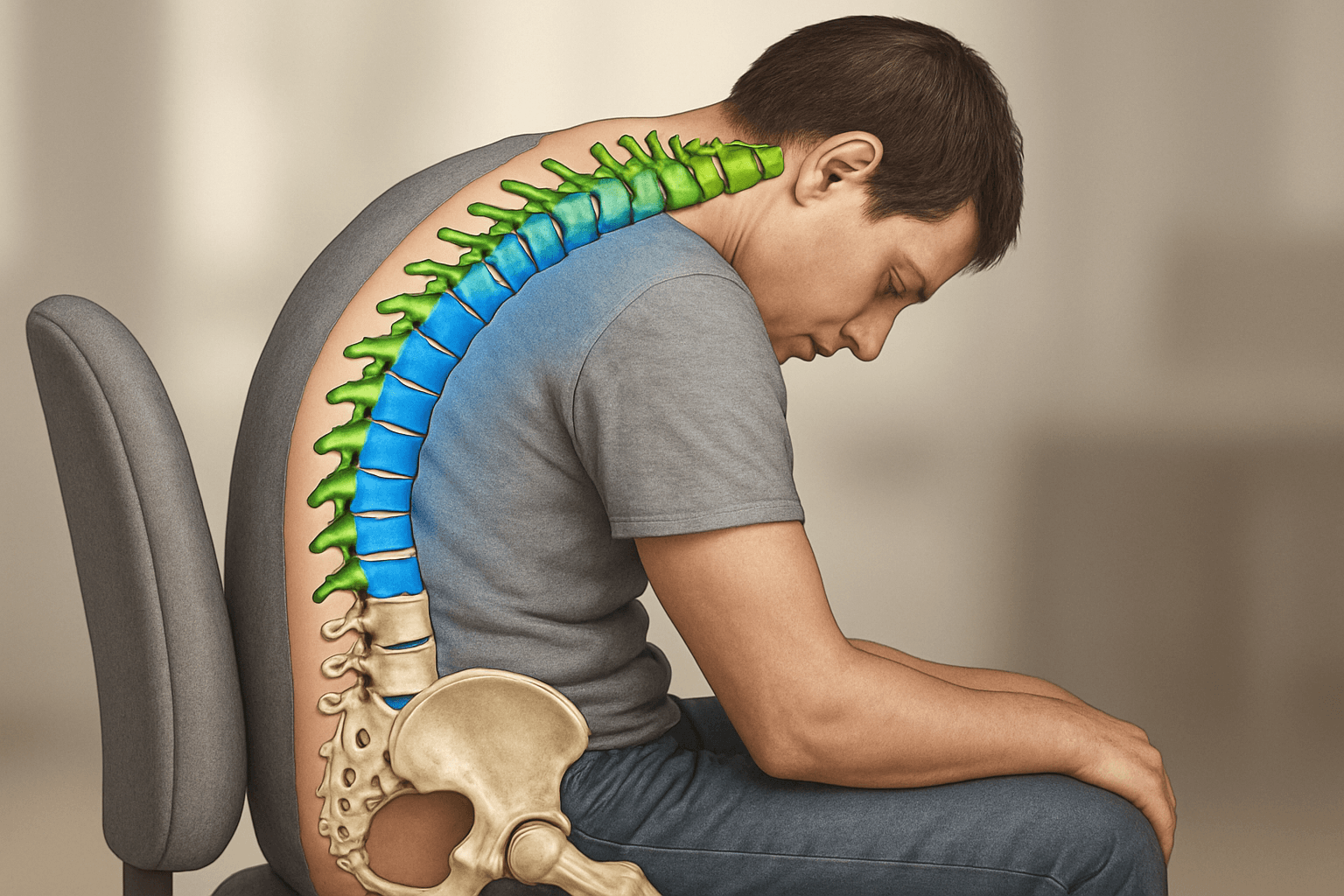
Movement requires coordination between multiple regions of the body. Walking, for example, involves the feet, ankles, knees, hips, pelvis, spine, shoulders, and nervous system working together rather than operating independently.
When one part of that system cannot contribute normally, another area may adapt.
Imagine that your right ankle becomes painful after an injury. Without consciously deciding to do so, you may begin spending less time on that leg. Your left leg then accepts more load, your pelvis may move differently, and your trunk may alter its position to maintain balance.
That adjustment can be helpful while the ankle recovers. If the altered movement continues after the original problem has improved, however, it may become your new default.
This interconnected perspective is one reason a broader posture correction assessment may consider more than the location where symptoms are currently being felt.
Jump To:
- TLDR Quick Guide
- What Are Body Compensation Patterns?
- Why Does the Body Compensate?
- Previous Injuries Can Leave Movement Habits Behind
- How Posture Can Become Part of the Pattern
- How Compensation Can Travel Through the Body
- Why Body Compensation Patterns May Become Painful
- Why Pain Can Appear Somewhere Else
- Common Signs You May Be Compensating
- Why Stretching the Painful Area May Not Be Enough
- Why Strengthening One Muscle Isn't Always the Whole Answer
- Sitting Can Reinforce Compensation Patterns
- Exercise Compensation Can Occur Too
- How a Structural Assessment May Help
- Can Compensation Patterns Be Changed?
- When Should Pain Be Professionally Assessed?
- Breaking the Cycle of Compensation
- Key Takeaways
- Frequently Asked Questions
TLDR Quick Guide
Body Compensation Patterns at a Glance
Body compensation patterns are movement or postural adaptations that develop when the body changes how it performs an activity in response to pain, injury, weakness, stiffness, habit, fatigue, or another limitation.
Important points include:
- Compensation is not automatically harmful.
- Short-term adaptations can help you remain functional.
- Problems may arise when compensations persist after they are no longer needed.
- A restriction in one area can influence movement elsewhere.
- Pain may appear away from the original problem.
- Repetitive activities can reinforce inefficient movement habits.
- Sitting and working positions can contribute to persistent postural habits.
- Previous injuries can influence movement even after symptoms improve.
- Treating only the painful area may not always address contributing factors.
- Persistent, worsening, or unexplained pain deserves appropriate professional assessment.
The key is not to assume that every asymmetry is abnormal. Human bodies naturally vary, and posture alone cannot reliably explain every episode of pain.
What Are Body Compensation Patterns?
Compensation Is the Body’s Workaround
A compensation occurs when the body modifies movement to accomplish a task despite a limitation elsewhere.
Suppose rotating through one hip is uncomfortable. You may unconsciously obtain additional movement from your pelvis or lower back.
If shoulder movement is restricted, you might elevate the shoulder blade or extend through the upper back to reach overhead.
If one knee hurts, you may place more weight through the opposite leg.
The body is still accomplishing the task, but it has changed how the task is performed.
Compensation Can Become Automatic
One of the challenges is that these adaptations do not always disappear immediately when the original problem improves.
Movement is highly habitual. Once the nervous system becomes accustomed to performing a task in a particular way, that strategy can begin to feel normal.
You may therefore be unaware that you stand unevenly, rotate more easily in one direction, or consistently favour one leg.
Why Does the Body Compensate?
Pain Is a Powerful Driver of Movement Changes
Pain naturally encourages protective behaviour.
If putting weight through one foot hurts, you will probably reduce pressure through it. If turning your neck in one direction is uncomfortable, you may begin rotating your shoulders or entire torso instead.
These responses are not necessarily mistakes.
During an acute injury, modifying movement can be a sensible protective response. The concern is whether the altered strategy remains long after the initial reason for it has changed.
Restricted Movement Can Shift Demand Elsewhere
A joint or region that does not move comfortably through the range required for a particular activity may cause neighbouring areas to contribute more.
For example, limited mobility around the hips can potentially influence how someone moves through the pelvis or lower back during certain tasks.
The relationship is rarely as simple as one tight joint directly “causing” pain somewhere else. Movement, loading, previous injuries, strength, activity level, sleep, stress, general health, and many other variables can influence symptoms.
Previous Injuries Can Leave Movement Habits Behind
The Pain May Resolve Before Normal Movement Returns
Think about how someone walks after spraining an ankle.
For several days or weeks, they may limp. That limp is an obvious compensation designed to avoid stressing the painful area.
As the ankle improves, the person may feel ready to return to normal activity before strength, mobility, confidence, and movement have completely recovered.
A subtler version of the altered gait may remain.
Over time, the person may not notice it at all.
Old Injuries Can Still Be Relevant
This is why a thorough musculoskeletal history often considers previous injuries, even when they happened years earlier.
An old knee injury does not automatically explain current back pain. But understanding previous injuries can help a practitioner investigate whether lasting movement adaptations might be contributing to current symptoms.
The goal is to identify plausible relationships rather than assume that every old injury is responsible for a new complaint.
How Posture Can Become Part of the Pattern
Posture Is Dynamic, Not a Single Perfect Position
Posture is sometimes presented as though everyone should maintain one ideal alignment throughout the day.
Human movement is more complicated.
People naturally change position, shift weight, cross their legs, lean, rotate, and relax. Variation itself is normal and often beneficial.
Problems may be more likely when someone repeatedly uses a limited range of positions for long periods, particularly when those positions are accompanied by discomfort, restricted movement, or high physical demands.
Repetition Reinforces Familiar Positions
Imagine working at a computer eight hours per day.
You consistently lean toward one monitor, rest on the same elbow, cross the same leg, and shift your pelvis toward one side.
One afternoon of doing this is unlikely to define your musculoskeletal health.
But repeated exposure over months or years can make certain positions and movements increasingly familiar. If symptoms develop, these habitual patterns may be worth considering as part of a broader assessment.
How Compensation Can Travel Through the Body
Movement Is Connected Across Multiple Regions
A change in one area can alter how another area performs a task because the body functions as an interconnected system.
Consider walking.
If one ankle has limited movement, the knee, hip, pelvis, or trunk may adjust to help the body continue moving forward.
Similarly, if turning the head becomes uncomfortable, a person may begin turning more through the upper back or entire torso.
This doesn’t mean every problem creates a predictable chain reaction. It means assessing movement often requires looking beyond a single joint.
Upright Posture discusses this broader concept further in its explanation of structural imbalance and whole-body symptoms.
Why Body Compensation Patterns May Become Painful
Some Tissues May Begin Doing More Work
When movement changes, workload can change with it.
Muscles that previously shared a task may no longer contribute equally. Certain tissues may be exposed to greater or unfamiliar loads, while others contribute less.
That can potentially contribute to:
- Muscular fatigue
- Stiffness
- Reduced movement tolerance
- Local tenderness
- Difficulty performing certain activities
- Recurring discomfort
Whether pain actually develops depends on many factors, including the person’s activity demands and capacity to tolerate those demands.
Pain Is More Complex Than Mechanics Alone
This distinction is important.
Pain cannot always be explained by posture, alignment, muscle tightness, or a single structural finding. Pain is influenced by biological, psychological, behavioural, occupational, and social factors.
Two people can have similar posture or movement patterns and completely different symptoms.
Therefore, compensation should be treated as one possible piece of the clinical picture—not a guaranteed explanation for pain.
Why Pain Can Appear Somewhere Else
The Painful Area May Be Carrying Extra Demand
Suppose your hip has become stiff and your lower back contributes more movement during everyday tasks.
Eventually, your back may become the region that feels uncomfortable.
Focusing exclusively on the back without considering hip movement could potentially overlook a relevant contributor.
This is one reason practitioners often examine surrounding areas during musculoskeletal assessment.
The Location of Pain Does Not Always Identify the Cause
Pain location is valuable information, but it does not always provide a complete diagnosis.
Symptoms may also involve referred pain, nerve irritation, systemic conditions, or other medical causes that cannot be explained by a compensation pattern.
Persistent or unexplained pain therefore deserves proper assessment rather than self-diagnosis based purely on posture.
Common Signs You May Be Compensating
Uneven Movement Can Provide Clues
Potential signs of compensation may include:
- Consistently shifting weight toward one leg
- Limping or shortening one stride
- Difficulty rotating equally in both directions
- Raising one shoulder during certain movements
- Repeatedly leaning to one side
- Moving the trunk excessively during arm or leg movements
- Feeling considerably tighter on one side
- Struggling with particular positions
- Recurrent discomfort during the same activities
None of these signs automatically proves there is a harmful compensation.
They simply provide information that may help guide further assessment.
Why Stretching the Painful Area May Not Be Enough
Tightness Can Sometimes Be a Response
When something feels tight, stretching it seems logical.
Sometimes that works.
In other situations, the sensation of tightness may be associated with how the body is controlling or loading an area rather than simply a muscle being physically “too short.”
Repeatedly stretching the same area without understanding why it keeps feeling tight may therefore produce only temporary relief.
Look at the Activity Producing the Symptom
Instead of asking only, “Which muscle feels tight?” it can be useful to ask:
- When does the symptom appear?
- What movements aggravate it?
- Does it happen after prolonged sitting?
- Does it change when walking?
- Is one side consistently different?
- Was there a previous injury?
- Have training or work demands recently changed?
Patterns often provide more useful information than a single isolated symptom.
Why Strengthening One Muscle Isn’t Always the Whole Answer
Movement Requires Coordination
Weakness can contribute to movement problems, but simply strengthening the muscle nearest the pain is not always sufficient.
A person may be strong during an isolated exercise yet struggle to coordinate that strength during walking, lifting, running, or another functional activity.
Effective rehabilitation often needs to consider strength alongside mobility, movement control, confidence, load tolerance, and the specific activity the person wants to perform.
The Goal Is Better Function
The objective should not necessarily be to make every muscle equally strong or every joint perfectly symmetrical.
Human bodies are naturally asymmetric.
A more useful goal is often to improve comfortable, efficient function while gradually building capacity for the activities that matter to the individual.
Sitting Can Reinforce Compensation Patterns
Long Periods in One Position Can Matter
Desk work does not automatically damage the spine.
However, remaining in one position for prolonged periods can contribute to stiffness and discomfort for some people, especially when combined with low activity levels or an unsuitable workstation.
Someone who repeatedly leans toward one side may also carry that preferred position into standing and movement.
Movement Variety Can Help
Simple strategies can include:
- Changing sitting positions periodically
- Standing and moving regularly
- Adjusting monitor placement
- Avoiding repeatedly leaning toward one side
- Taking short walking breaks
- Alternating tasks when possible
The objective is not to maintain rigid “perfect posture” all day.
It is to give the body more movement variety.
Exercise Compensation Can Occur Too
Your Body Can Find Another Way to Complete the Rep
Compensation is particularly noticeable during exercise.
Imagine performing an overhead movement when shoulder mobility is limited. Instead of obtaining all the required motion from the intended regions, you may arch your lower back or change your ribcage position to complete the movement.
The repetition still gets completed, but the strategy has changed.
If the load increases without addressing the underlying limitation, the compensatory strategy may become more pronounced.
Technique Should Match Your Current Capacity
Exercise should be adapted to the individual.
Reducing load, modifying range of motion, changing exercise selection, or improving technique can sometimes be more useful than forcing the body through a movement it currently cannot perform comfortably.
Pain during exercise should not automatically be interpreted as something you need to push through.
How a Structural Assessment May Help
Assessment Should Look Beyond the Symptom
When pain repeatedly returns, evaluating only the painful spot may provide an incomplete picture.
A broader assessment may consider:
- Posture
- Movement
- Previous injuries
- Mobility
- Strength
- Daily activities
- Work demands
- Exercise habits
- Symptom behaviour
- Functional limitations
The specific examination will depend on the practitioner and the person’s presentation.
At Upright Posture, Advanced BioStructural Correction is the clinic’s primary approach for evaluating and addressing structural and postural patterns. Whether that approach is appropriate for a particular person should be determined through individual assessment rather than assuming every pain problem has the same mechanical cause.
Can Compensation Patterns Be Changed?
Habits Can Often Be Modified
The body is adaptable in both directions.
Just as repeated movement can establish a compensatory strategy, appropriately selected movement and rehabilitation may help develop alternative strategies.
Depending on the individual, this might involve:
- Improving mobility
- Building strength
- Adjusting activity load
- Changing workstation habits
- Practising movement control
- Gradually returning to activity
- Addressing an unresolved injury
- Receiving appropriate hands-on or rehabilitative care
There is no single correction that applies to everyone.
Change Usually Requires Repetition
A movement habit that developed over months or years may not disappear after one treatment or exercise session.
The body needs opportunities to practise different strategies.
Consistency generally matters more than trying to force rapid change.
When Should Pain Be Professionally Assessed?
Persistent Symptoms Deserve More Than Guesswork
Consider professional assessment when pain:
- Continues despite reasonable self-care
- Frequently returns
- Is progressively worsening
- Significantly limits daily activity
- Began after an injury
- Interferes with sleep or mobility
- Is accompanied by neurological symptoms
- Has no obvious explanation
A qualified healthcare professional can help determine whether the problem appears musculoskeletal or requires another type of evaluation.
Some Symptoms Need Urgent Medical Attention
Not every pain problem should be attributed to posture or compensation.
Seek urgent medical advice for concerning symptoms such as significant new weakness, loss of bladder or bowel control, numbness around the saddle area, severe symptoms following major trauma, chest pain, difficulty breathing, or other sudden and severe unexplained symptoms.
When symptoms fall outside a straightforward musculoskeletal pattern, appropriate medical evaluation should take priority.
Breaking the Cycle of Compensation
Step 1: Identify the Pattern
Start by understanding when symptoms occur and which activities appear to trigger them.
Do not assume the painful area is automatically the original source.
Step 2: Consider Relevant History
Previous injuries, changes in activity, work demands, exercise habits, and prolonged periods of reduced movement can all provide useful context.
A timeline can sometimes reveal connections that are difficult to notice otherwise.
Step 3: Assess Rather Than Guess
If the problem persists, professional assessment can help identify plausible contributing factors and rule out problems requiring different care.
This is more useful than continually switching between stretches or exercises based solely on where the body hurts that day.
Step 4: Address Relevant Contributors
Treatment or rehabilitation should reflect the findings.
For one person, that may mean improving mobility. Another may need progressive strengthening, workload changes, movement retraining, or another form of care.
Step 5: Build Capacity Gradually
Long-term improvement usually requires more than temporary symptom reduction.
Building strength, mobility, confidence, and tolerance for normal activities can help the body cope with everyday demands without constantly relying on the same protective strategies.
Key Takeaways
What to Remember About Body Compensation Patterns
- Body compensation patterns are adaptations the body uses to keep functioning when normal movement is uncomfortable or limited.
- Compensation itself is not automatically harmful.
- Pain, injury, restricted mobility, weakness, fatigue, repetitive activity, and movement habits can contribute to compensatory strategies.
- Short-term compensation may be useful during recovery.
- Problems can arise when an altered movement strategy becomes persistent or places excessive demand on other areas.
- Previous injuries may influence movement after the original pain has resolved.
- The place where you feel pain is not necessarily the only area worth assessing.
- Posture is dynamic, and there is no single perfect position everyone must maintain.
- Stretching or strengthening the painful area alone may not address every contributing factor.
- Pain is complex and should not automatically be blamed on posture or structural alignment.
- Persistent or worsening symptoms deserve appropriate professional assessment.
- The goal should be comfortable, capable movement—not achieving artificial physical perfection.
Frequently Asked Questions
What are body compensation patterns?
Body compensation patterns are movement or postural adaptations that allow the body to continue performing a task when another area is painful, restricted, weak, or otherwise limited. They may involve shifting load, changing joint movement, or relying more heavily on another part of the body. These adaptations can be useful temporarily but may deserve attention when they persist or are associated with recurring symptoms.
Can body compensation patterns cause pain somewhere else?
Changes in movement can alter how forces and workloads are distributed across muscles and joints, which may contribute to symptoms in another region. However, pain has many possible influences, so a compensation pattern should not automatically be assumed to be the cause. Persistent or unexplained symptoms are best evaluated in the context of the person’s complete health and movement history.
Can an old injury still affect how I move years later?
An old injury can sometimes leave behind changes in strength, mobility, confidence, or movement habits even after the original pain disappears. Whether those changes are relevant to current symptoms depends on the individual and requires assessment rather than assumption. Providing a practitioner with a complete injury history can help identify potentially useful connections.
Can posture correction fix compensation patterns?
Changing posture or movement habits may be useful when assessment identifies them as relevant contributors, but there is no single ideal posture that eliminates all pain. Effective care may also involve mobility, strength, activity modification, load management, rehabilitation, or other appropriate treatment. The right approach depends on why the compensation developed and what is currently limiting function.
How long does it take to change a compensation pattern?
There is no universal timeline because compensation patterns vary according to their cause, duration, physical demands, previous injuries, and individual health. Some movement changes can occur relatively quickly, while established habits or longstanding limitations may require consistent rehabilitation over a longer period. Progress is better judged by improvements in comfort, movement, function, and activity tolerance than by expecting the body to become perfectly symmetrical.