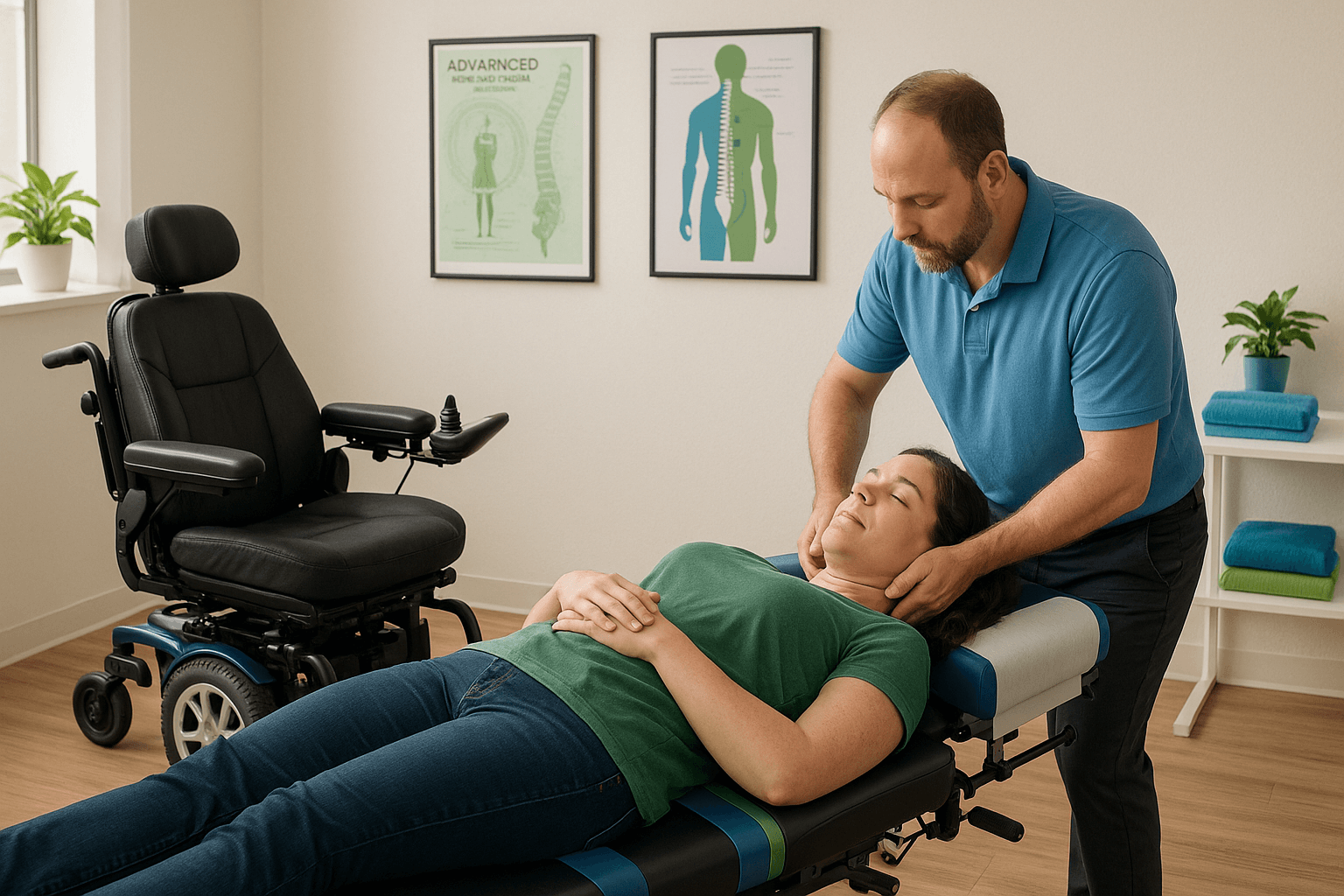
Are you’re looking for “Gonstead chiropractic near me”, or a chiropractic clinic using the Gonstead system?
Before you make that decision I just wanted to help you understand what Gonstead chiropractic is and also tell you a little about the technique that we use which is called Advanced BioStructural Correction.
Did you know that there are over 200 types of chiropractic adjustment methods that a chiropractor can choose from in order to detect and treat your condition?
The most common technique is a form of joint manipulation known as diversified chiropractic technique. The treatment involves a quick and firm force by hand which usually involves twisting, pulling or pushing a bone to attempt to get a release. This type of treatment is also known as “High-Velocity Low-Amplitude” (HVLA) joint manipulation. Gonstead chiropractic is also very popular and Gonstead technique detects where to manipulate in a similar way and also uses HVLA manipulation.
Jump To:
- TLDR – Quick Guide
- What is Gonstead chiropractic?
- What is the Gonstead technique?
- Is Gonstead chiropractic safe?
- Is Gonstead chiropractic effective?
- What are spinal misalignments / subluxations?
- Key Takeaways
- FAQs
TLDR – Quick Guide
- Gonstead chiropractic is a highly precise and thorough approach to spinal adjustments.
- It focuses on detailed assessments, including X-rays and palpation, to pinpoint problem areas.
- The technique aims to restore spinal alignment, improve nerve function, and relieve pain.
- Perfect for those with chronic pain, postural issues, or nerve-related conditions.
- A Gonstead chiropractor near you can offer targeted, evidence-based care for long-term relief.

What is Gonstead chiropractic?
Gonstead chiropractic is named after its founder Clarence Selmer Gonstead (1898 – 1978), an American chiropractor. He created the Gonstead technique and owned a large chiropractic facility in Mount Horeb, Wisconsin. It is one of hundreds of chiropractic techniques in the world and has been made more popular by several Gonstead chiropractors on social media recent years.
What is the Gonstead technique?
Gonstead technique involves spinal manipulation and adjustments of other joints too; usually it is done by hand. Manipulation is often directed at vertebral (spinal) misalignments / subluxations. It is the goal of a Gonstead chiropractor to restore and maintain optimal health by locating and correcting any interference to the nervous system caused by vertebral subluxation complex.
Gonstead chiropractors will base their treatment on your posture, symmetry, and tissue tone. They may also use an instrument called a “Nervoscope” which can detect hot or cold spots along the spine. They also feel the spine using static palpation looking for areas of swelling, oedema, and changes in tissue tone. Motion palpation can also be used which is feeling for areas of hypo and hyper mobility. Unfortunately, testing the quality of motion in a joint has been shown to be unreliable (https://bit.ly/34QuWbm). When I used to practice this way, I also would be frustrated with this method as sometimes it seemed to help, other times it did not help, and occasionally it would hurt people! Both methods of palpation have been found to be unreliable indicators.
Often Gonstead technique also utilises x-ray analysis to determine the direction and location for the adjustment.
Is Gonstead chiropractic safe?
Many Gonstead adjustments to delivered into the spine from behind which further x-ray analysis in the 1990’s by another chiropractor called Jesse Jutkowitz showed causes further misalignment. Gonstead technique was also developed before further discoveries in spinal biomechanics in the 1970’s showed the importance of the meninges (the three membranes that envelop the brain and spinal cord), to spinal motion and overall biomechanical function of the body. So Gonstead technique does not take these later and vital discoveries into consideration.
It is a common problem with many chiropractic techniques in that they generally utilise specific spinal manipulation to free joints in the spine or other areas of the body that are not moving properly. But by “freeing” up stuck joints (which can give relief and improve local joint motion), the chiropractor often inadvertently pushes the bone into a worse overall biomechanical position. This may or may not result in immediate pain but will always worsen the overall alignment and biomechanical function of the body in a way that is not always immediately obvious.
Is Gonstead chiropractic effective?
It depends on what you are measuring and what you define as “effective”. If you are looking for local pain relief and local improvement of joint motion, then you could say that the Gonstead Technique is effective. However, if you are defining “effective” as an improvement not only in local but also global motion, posture, and function my personal research and experience would say that it is not effective for that. So, if you looking to just get out of pain and are not so interested in your long-term structural health than Gonstead technique may be suitable for you.
I just want to be clear that I am not picking on Gonstead chiropractic, I just want to present some facts and could also say very similar things about virtually all other spinal manipulation techniques used by chiropractors, osteopaths, physiotherapists, massage therapists and so on. That is because we generally get taught to work on the symptomatic area. E.g., the area that is either sore, swollen, stiff, hot, misaligned, tight, tense, overactive, underactive, etc. We also get taught techniques (whether that is soft tissue, manipulation, needling, etc) to “free up”, “loosen”, “relax”, that area; or perhaps to improve the blood flow, lymph flow, nerve conduction, etc. This is short term care without proper consideration of the long-term effects. In Advanced BioStructural Correction these areas are known as areas of compensation and are not where the treatment should be delivered.
This is because the human body is much more complicated than that. Spinal mechanics especially are incredibly complicated so spinal manipulation is useful but cannot correct the problem that many of us are aiming to help, namely, to optimise biomechanical function for long term health.

What are spinal misalignments / subluxations?
Areas in your spine that have become very stiff, inflamed or painful are thought to often be the result of a misalignment. In chiropractic this is called a subluxation and sometimes a vertebral subluxation complex (VSC). Some chiropractors do not think these misalignments exist and have a different understanding of the situtation and base their treatment on that. Gonstead chiropractors do acknowledge subluxations and part of Gonstead technique is to try to correct them.
I have learned that not all subluxations need correcting as I noticed many years ago that adjusting some subluxations resulting in a positive effect and sometimes a negative effect. There was no way to predict which way it would go. I became so frustrated that I almost changed careers! Thankfully, some further research (which was not easy to come across) helped me to understand subluxations better.
There are two types of misalignment / subluxation – primary and secondary types.
Primary subluxations occur when bones have misaligned in directions that our own muscles cannot self-correct. This needs to be corrected by the practitioner as there is no way your body will be able to do it for you. Improvement of the primary subluxation results in a positive outcome, e.g. pain relief, improved joint motion, improved nerve conduction, etc.
Secondary subluxations occur when bones have misaligned in directions that our own muscles can self-correct, but our bodies deliberately do not because they are part of a compensation pattern to help you manage the stress of the primary subluxations. If the practitioner manipulates these types of subluxation, you will get a negative result, e.g. worse posture, worse breathing, perhaps even pain.
I learned that hard way (because my own body got wrecked with “normal” chiropractic treatment), that if the primary misalignments are not corrected properly then all any chiropractor (or other health professional) is doing is just managing the problem but not eliminating it. Strictly speaking, it is harmful.
This means that unless a chiropractic technique involves identifying exactly;
- which primary subluxations are out of place,
- the direction they are out of place,
- the exact method to correct each bone
- the correct order to perform the manipulations
the results would be inconsistent and are not tackling the underlying problem. Unfortunately, methods such as Gonstead technique do not differentiate between primary and secondary subluxations and their tests are being misled by areas of the body that are compensating for the primary misalignments /subluxations. These other areas are often the site of pain, stiffness, swelling and poor movement but they have become that way as they are overworked.
Manipulation of these “compensating bones/joints” can give short term relief but only the exact correction of the primary misalignments / subluxations will improve the underlying issue properly. When you treat the correct area properly, you always get a positive result; no more results where there is no benefit and no more making the situation worse.
Generally, I now find that symptoms can be very misleading, e.g. where it hurts is not the site of the actual issue. We therefore use a completely different method to detect where to treat which is based on your balance. A well aligned body will be stable i.e. remains upright when completely relaxed and is inherently resistant to outside forces.
So, in Advanced BioStructural Correction, a test called Objective Synchronous Testing has been developed to accurately detect the primary misalignments / subluxations that need correcting and to also detect other misalignments / subluxations which need to be left out as they are compensations.
Symptoms can be misleading. Even for professionals!
More About Compensations
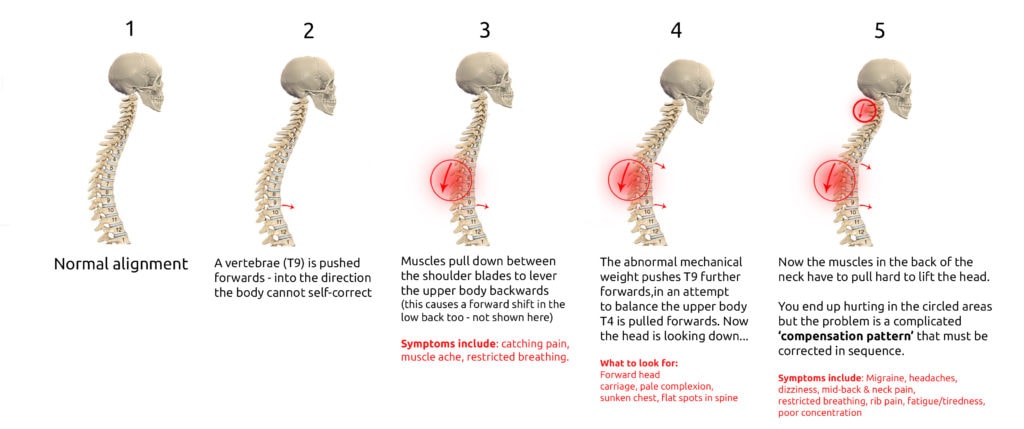
When a bone becomes out of place in a direction the body cannot self-correct, the natural and usual response is for the body to begin to twist, torque and bend to compensate for the imbalance caused by the bone out of place.
This compensating behaviour results in the pulling on and stressing of the tissues and organs of the body such as the nervous system, muscles, joints, organs, and vascular system.
This ultimately leads to the production and presentation of symptoms in the body such as joint and muscle pain, poor posture, pins and needles/numbness, weakness, difficulty breathing, brain fog, osteoarthritis and more.
These compensations are not the site of the actual injury. The true origin is a bone or bones out of place in a direction that the body cannot self-correct.
These compensations are what almost everyone else in the medical and non-medical profession focuses on in their treatment and not the true cause or origin. Examples of a site of compensation are tight muscles, osteoarthritis, hard/calloused skin, etc.
Treating these areas can provide short term relief but unless you tackle the root of the problem, it will not improve your overall biomechanical health in the long-term.
An example of a primary misalignment causing compensations
Aside from not tackling the underlying issue, releasing compensations makes it harder for your body to cope with the primary injury. Our bodies have adapted for survival over a long period of time, and the compensations are there for a reason. This is why you often need to keep repeating the chiropractic treatment to manage your condition – you are fighting against your body. Messing with compensations can make you worse!
Try Advanced BioStructural Correction instead of Gonstead Technique
So if you’re still looking for “Gonstead chiropractic near me”, or a chiropractic clinic using the Gonstead system feel free to give it a try.
However, treating the bones out of place correctly is what sets Advanced BioStructural Correction™ apart from every other physical treatment modality and is what makes it so unique and effective when applied correctly. This is why we only use this method in our clinic and sets us apart from Gonstead Chiropractors.
Another unique aspect of the treatment is the releasing of scar tissue that builds up inside the spinal canal called “meningeal adhesions”. This is done with very specific stretches to the spine itself.
Treatment with Advanced BioStructural Correction ™ results in symptom relief throughout the body and simultaneous posture correction. The aim being, to not only to resolve the symptoms but to reverse the underlying condition and return your body back to normal.
Importantly, we have an incredibly low rate of side effects, and it is very unusual for our patients to not get life-changing results.
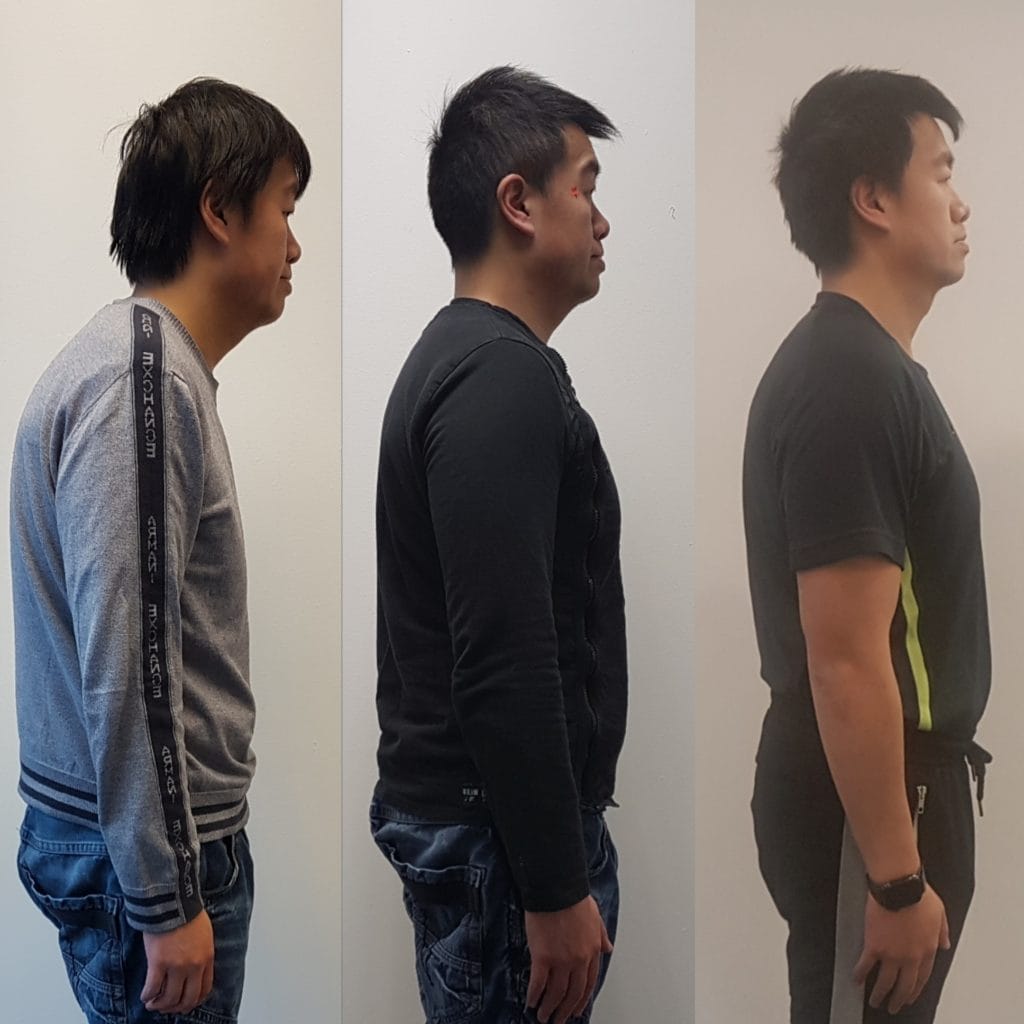
Typical results
Patient is standing completely relaxed in both photos.
More upright = less stress on the bones, muscles, nerves and other tissues = less symptoms and better overall function of virtually all body systems.
Learn more about Advanced BioStructural Correction with this short video
In a survey conducted of our clients in 2022, we found:
99% rate our treatment effective.
100% noticed posture improvement.
99% had symptom improvement.
99% noticed better breathing.
99% benefitted from better movement, focus, energy, sleep mood and productivity.
99% would recommend us to others
Compared to the results I had been getting with previous methods and current competing techniques and professions, this is astoundingly effective and consistent!
Find out more
You can learn more about primary injuries and compensations in this video. It will also teach you how these lead to many symptoms you may be experiencing.
GET YOUR BODY AND YOUR LIFE BACK
If you would like to find out more about our treatment please get in touch with us to discuss your problem.
You can also BOOK A FREE CONSULTATION HERE.
You can also find out more here too!
u can also find out more here too!

By Dr Lucky Gidda DC
MChiro (Hons), BEng (Hons), PGCert
Level 3 Registered Advanced BioStructural Correction Practitioner
Registered Endonasal Cranial Correction Practitioner
GCC 03384
Lucky Gidda can be contacted for free consultations, biomechanics assessments, and ergonomic assessments. He specialises in severe chronic cases such as compression fractures, spondylolisthesis, multi level disc prolapse, and scoliosis. He also has a keen interest in movement disorders, cerebral palsy and autism. He sees people of all ages but especially loves working with babies, children and teens.
Key Takeaways
- Gonstead chiropractic is known for its accuracy in diagnosing and treating spinal issues.
- Uses X-rays, motion analysis, and hands-on assessment to guide treatment.
- Adjustments are highly specific, focusing only on misaligned vertebrae.
- Effective for back pain, neck pain, sciatica, and joint dysfunction.
- A Gonstead chiropractor provides a customized, science-backed approach to spinal health.
FAQs
How is Gonstead chiropractic different from regular chiropractic?
It uses a more detailed assessment process, including X-rays and palpation, to ensure precision in adjustments.
Is Gonstead chiropractic safe?
Yes! The method is highly specific, reducing unnecessary adjustments and ensuring a safe, effective treatment.
What conditions can Gonstead chiropractic treat?
It helps with back pain, sciatica, neck pain, headaches, and postural issues.
Will I need X-rays before treatment?
Most Gonstead chiropractors use X-rays to accurately diagnose misalignments and create a tailored treatment plan.
How long does a Gonstead adjustment take?
A session typically lasts 20-30 minutes, depending on the complexity of the case.