You finish a long day at your desk, stand up, and suddenly feel that familiar ache across your lower back.
You stretch, walk around, and eventually feel better. Problem solved, right?
Not quite.
The next day, the discomfort returns after another few hours in your chair. And the day after that? Same story.
Lower back pain after sitting is a common frustration, particularly for office workers, drivers, and anyone spending long periods in one position.
While sitting itself isn’t necessarily harmful, prolonged inactivity, repetitive movements, and underlying musculoskeletal conditions may contribute to recurring discomfort.
At Upright Posture, a chiropractic clinic in Sutton Coldfield, Birmingham, understanding how posture, movement, and everyday habits relate to back discomfort forms part of its approach to musculoskeletal care.
So, why does lower back pain after sitting keep returning, and what can you do about it?
Let’s break it down.
Jump to:
TLDR – Quick Guide
If lower back pain after sitting keeps interrupting your day, here are the essentials:
- Sitting isn’t automatically bad: Staying in one position for too long may be more relevant than the position itself.
- Muscle fatigue can contribute: Prolonged sitting may leave your back feeling stiff or uncomfortable.
- Your workstation matters: Poorly arranged equipment can make everyday tasks unnecessarily demanding.
- Movement helps: Regular breaks and comfortable activity may reduce stiffness.
- Underlying conditions are possible: Disc-related problems, nerve irritation, and other conditions can produce recurring symptoms.
- Posture isn’t the whole story: Sleep, stress, physical activity, and general health may also influence back pain.
- Persistent symptoms deserve attention: Professional assessment can help identify the cause and guide appropriate care.
The bottom line: Managing lower back pain after sitting often involves changing how you work, move, and respond to symptoms rather than searching for one perfect sitting position.
Detailed Breakdown
1. You’re Staying in One Position for Too Long
Here’s something worth remembering: your back doesn’t need you to sit perfectly. It needs opportunities to move.
Whether you sit upright, lean backwards, or occasionally slouch, remaining in the same position for extended periods may contribute to stiffness and discomfort.
Your back muscles help support your body while you’re seated.
Over time, maintaining a static position can become tiring, especially when you’re focused on work and barely move.
You might notice:
- Stiffness when standing up
- A dull ache across the lower back
- Discomfort after long meetings
- Temporary relief after walking
- Symptoms that return during another sitting session
What helps? Change positions regularly and take brief movement breaks throughout the day.
You don’t necessarily need an elaborate stretching routine. Standing, walking to get water, or moving around your workspace may be enough to interrupt prolonged sitting.
2. Your Workstation May Be Making Sitting Uncomfortable
A poorly arranged workstation can make even simple tasks feel more demanding.
For example, a screen positioned too far away may encourage you to lean forwards, while a chair that’s too high can leave your feet unsupported.
Neither setup automatically causes back pain, but both may contribute to discomfort during long working hours.
Common workstation issues include:
- A monitor positioned too low or too far away
- A chair that doesn’t feel supportive
- A keyboard or mouse that’s difficult to reach
- Limited space to change positions
- Sitting for hours without breaks
The clinic’s article on Poor Work Ergonomics explores how working environments may influence musculoskeletal comfort.
What helps? Adjust your workstation so frequently used equipment is within easy reach and your body feels comfortably supported.
Remember that even an expensive ergonomic chair can’t replace regular movement.
3. Your Muscles May Be Fatigued or Deconditioned
Your back, abdominal, hip, and pelvic muscles work together during everyday activities.
If you spend much of the day sitting and have limited opportunities for physical activity, some tasks may begin to feel more demanding.
Reduced strength or endurance can sometimes contribute to discomfort, although muscle weakness isn’t the cause of every episode of back pain.
For example, someone who spends eight hours at a desk and rarely exercises may find prolonged sitting or standing uncomfortable.
A gradual strengthening programme may help improve tolerance for daily activities.
Useful activities can include:
- Walking
- Gentle mobility exercises
- Appropriate abdominal and back strengthening
- Hip and leg exercises
- Gradually increasing general physical activity
The goal isn’t to build a perfectly rigid core. It’s to improve your ability to move comfortably and manage everyday physical demands.
If exercise repeatedly aggravates your symptoms, seek professional guidance before increasing intensity.
4. Your Sitting Habits May Be Contributing to Discomfort
Have you ever caught yourself sitting on the edge of your chair, leaning towards your laptop, or twisting to look at a second monitor?
These positions aren’t necessarily harmful.
However, if a particular position consistently aggravates your symptoms, changing it may help.
The clinic’s guide to the Best Sitting Posture discusses ways to approach sitting more comfortably.
Practical adjustments include:
- Keeping your feet comfortably supported
- Positioning your screen at a convenient height
- Sitting close enough to reach your keyboard without stretching
- Using a backrest when it feels helpful
- Alternating between different comfortable positions
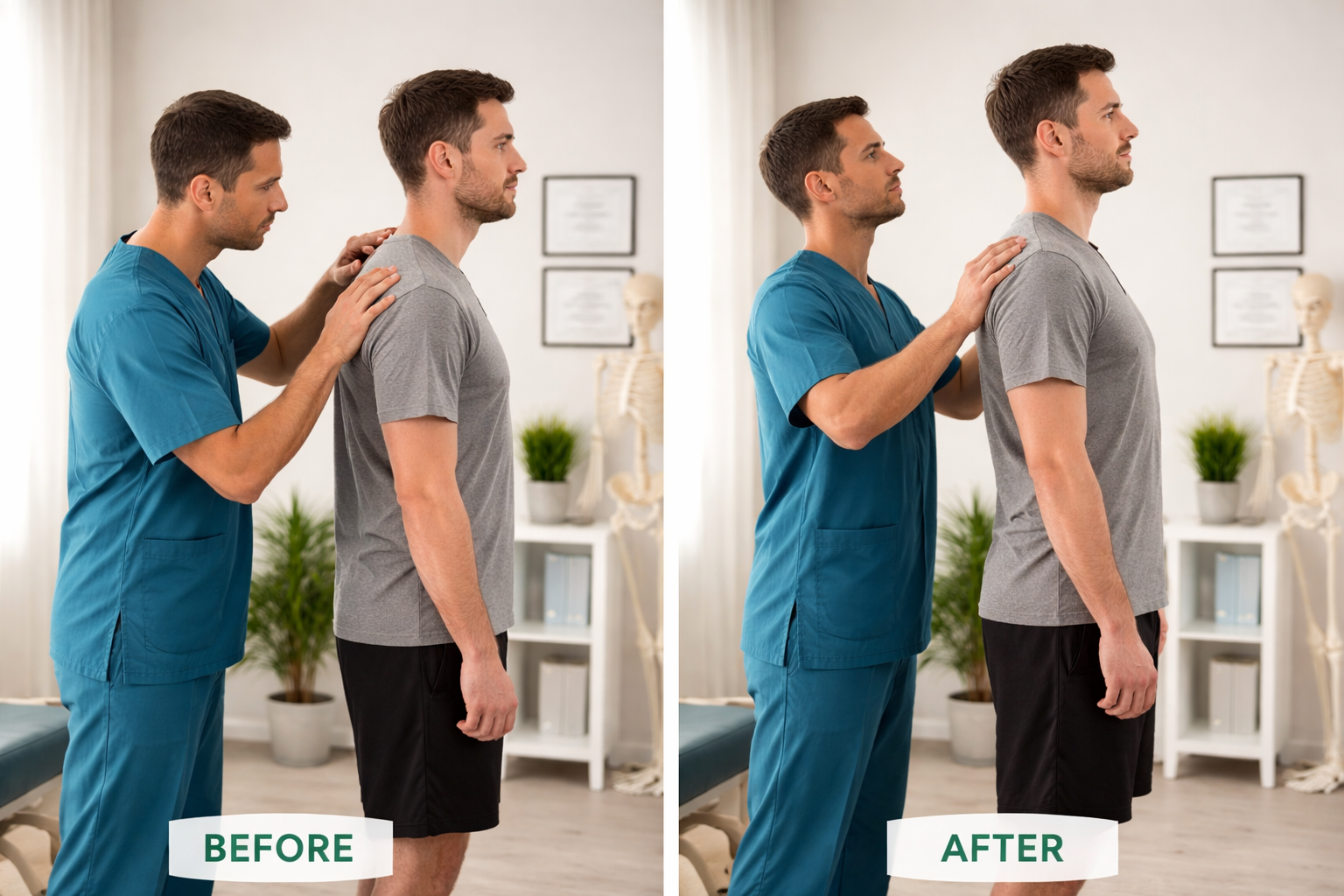
Some people also explore Posture Correction when managing recurring musculoskeletal discomfort.
However, there is no single sitting posture proven to prevent all lower back pain.
Rather than forcing yourself to sit perfectly upright for hours, focus on comfort, movement, and reducing activities that consistently aggravate symptoms.
5. An Underlying Back Condition May Be Involved
Sometimes, lower back pain after sitting isn’t simply related to your desk setup.
Several conditions can contribute to recurring discomfort.
These include:
- Non-specific lower back pain: Pain without one clearly identifiable structural cause.
- Disc-related problems: Some spinal disc conditions can cause back pain or irritation of nearby nerves.
- Sciatica: Nerve-related symptoms that may travel from the lower back into the buttock or leg.
- Joint-related discomfort: Certain spinal or surrounding joint conditions may contribute to pain.
- Inflammatory conditions: Less commonly, inflammatory disorders can cause persistent back stiffness and discomfort.
If your symptoms include pain travelling down one leg, tingling, numbness, or weakness, nerve involvement may need consideration.
The clinic’s information on Sciatica, Slipped Discs and Pinched Nerves provides further background.
However, not every case of recurring lower back pain indicates a slipped disc or trapped nerve.
A clinical assessment can help determine whether symptoms suggest a specific condition or are more consistent with non-specific back pain.
6. You’re Changing How You Move Because of Discomfort
When your back hurts, you may unconsciously adjust how you move.
Perhaps you lean to one side when standing, avoid bending forwards, or shift your weight when getting out of a chair.
These adaptations can be understandable responses to pain.
However, repeatedly avoiding certain movements may sometimes reduce confidence or make everyday activities feel more difficult.
The clinic’s article on Spinal Compensation and Hidden Pain explores the idea that changes in movement may be associated with discomfort elsewhere.
It’s important to recognise that compensatory movements aren’t automatically harmful or proof of structural misalignment.
People naturally move differently depending on fatigue, flexibility, pain, and the task they’re performing.
What helps? Gradually rebuilding comfortable movement and confidence may be more useful than trying to eliminate every variation in posture.
7. You’re Only Managing the Pain, Not the Contributing Factors
Picture this.
Your back starts aching after several hours at your desk. You stand up, stretch for thirty seconds, and feel better.
Then you sit down for another three hours without moving.
Unsurprisingly, the discomfort returns.
Temporary relief can be helpful, but recurring lower back pain after sitting may require a broader approach.
Contributing factors might include:
- Long periods without movement
- Limited physical activity
- Repetitive work demands
- An uncomfortable workstation
- Poor sleep
- Stress or fatigue
- An underlying musculoskeletal condition
Not every factor will apply to everyone.
That’s why an individualised assessment can be useful when symptoms persist.
For people exploring Back Pain Relief, understanding the relationship between symptoms, movement, and daily activities is an important starting point.
The goal is to identify manageable changes that improve comfort and function over time.
Practical Ways to Reduce Lower Back Pain After Sitting
Understanding the possible causes is useful. Knowing what to change tomorrow morning is even better.
Take Regular Movement Breaks
Try standing or walking briefly every 30–60 minutes as a practical starting point.
This isn’t a strict medical rule, and the ideal frequency varies between individuals.
The important thing is to avoid remaining uncomfortable in one position for prolonged periods.
Adjust Your Desk Setup
Keep your screen, keyboard, and mouse positioned so you can work comfortably.
Make sure your chair provides suitable support and your feet can rest comfortably.
You don’t need a complicated workstation makeover to make useful adjustments.
Strengthen Your Back and Surrounding Muscles
Regular physical activity can help improve strength, endurance, and confidence in movement.
Walking, suitable resistance exercises, and gentle mobility work may all be helpful.
Start at a manageable level and increase gradually.
Avoid Prolonged Bed Rest
If your back is uncomfortable, complete inactivity may contribute to stiffness and reduced function.
For many common episodes of lower back pain, continuing comfortable everyday activities is preferable to extended bed rest.
However, follow individual medical advice if you’ve experienced a significant injury or have another condition requiring specific precautions.
Review Your Daily Routine
Notice when your symptoms appear.
Does lower back pain after sitting begin after one hour, three hours, or only after a demanding day?
Tracking these patterns may help you identify useful adjustments.
Know When to Seek Professional Help
If your symptoms are persistent, worsening, or interfering with work and sleep, consider arranging a clinical assessment.
People looking into Back Pain Relief in Birmingham can explore the clinic’s discussion of local care options.
Seek urgent medical advice for new or progressive leg weakness, significant neurological symptoms, fever with concerning back pain, or severe pain following an injury.
Seek emergency medical assessment if you develop new bladder or bowel dysfunction, numbness around the genitals or inner thighs, or rapidly worsening weakness in both legs.
These symptoms can indicate serious nerve compression and should not be managed through posture changes or home exercises.
Can Better Posture Prevent Lower Back Pain After Sitting?
Not necessarily.
Posture can influence comfort, but the relationship between sitting positions and back pain is complex.
Some people sit with rounded backs for long periods without symptoms. Others experience discomfort despite maintaining an upright position.
That doesn’t mean workstation adjustments are pointless.
It means posture should be considered alongside movement, activity levels, sleep, stress, and other health factors.
Instead of asking, “Am I sitting perfectly?” try asking, “Can I work comfortably, change positions regularly, and move without unnecessary discomfort?”
That’s a more practical goal for most people.
Key Takeaways
Lower back pain after sitting often returns because the factors contributing to discomfort haven’t changed.
While prolonged sitting may be part of the picture, it’s rarely useful to blame one posture or assume your spine is out of alignment.
Remember these essential points:
- Sitting isn’t inherently harmful: Prolonged time in one position may contribute to discomfort.
- Movement breaks matter: Changing positions regularly can help reduce stiffness.
- Workstation comfort matters: Small ergonomic adjustments may make daily tasks easier.
- Strength and activity matter: Gradual exercise can improve tolerance for everyday demands.
- Symptoms need context: Recurring pain doesn’t automatically mean you have a slipped disc.
- Persistent pain deserves assessment: Professional guidance can help identify appropriate next steps.
If lower back pain after sitting keeps returning, don’t focus solely on finding the perfect chair or forcing yourself to sit upright all day.
The better approach is to understand your symptoms, improve movement habits, and address the factors that may be contributing to recurring discomfort.
FAQs
1. Why does my lower back hurt every time I sit for a long time?
Lower back pain after sitting may be associated with prolonged inactivity, muscle fatigue, uncomfortable working positions, or an underlying musculoskeletal condition. Staying in one position for extended periods can make some people feel stiff or uncomfortable. If the pain keeps returning or worsens, a healthcare professional can help identify possible contributing factors.
2. Is lower back pain after sitting a sign of a slipped disc?
Not necessarily, because many cases of lower back pain occur without a specific disc problem. A herniated disc may be considered when symptoms include pain travelling down the leg, tingling, numbness, or weakness. A clinical assessment is needed to determine whether nerve irritation or another condition may be involved.
3. What is the best sitting position for lower back pain?
The best sitting position is generally one that feels comfortable and allows you to change positions regularly. Supporting your feet, adjusting your screen height, and using a suitable backrest may help reduce discomfort. There is no single perfect sitting posture that prevents lower back pain for everyone.
4. Can walking help lower back pain after sitting?
Gentle walking may help reduce stiffness and maintain mobility after prolonged sitting. Regular physical activity can also support general strength and functional ability over time. Start with manageable distances and seek advice if walking significantly worsens your symptoms.
5. When should I seek treatment for lower back pain after sitting?
Consider professional assessment if lower back pain after sitting persists, worsens, or interferes with everyday activities. New or progressive leg weakness, significant numbness, or other concerning neurological symptoms require prompt medical attention. Bladder or bowel changes, numbness around the groin, or rapidly worsening weakness in both legs require emergency medical assessment.